Southern Ontario local intelligence
Southern Ontario Salon Local Intelligence Brief
Reports · Human BXG
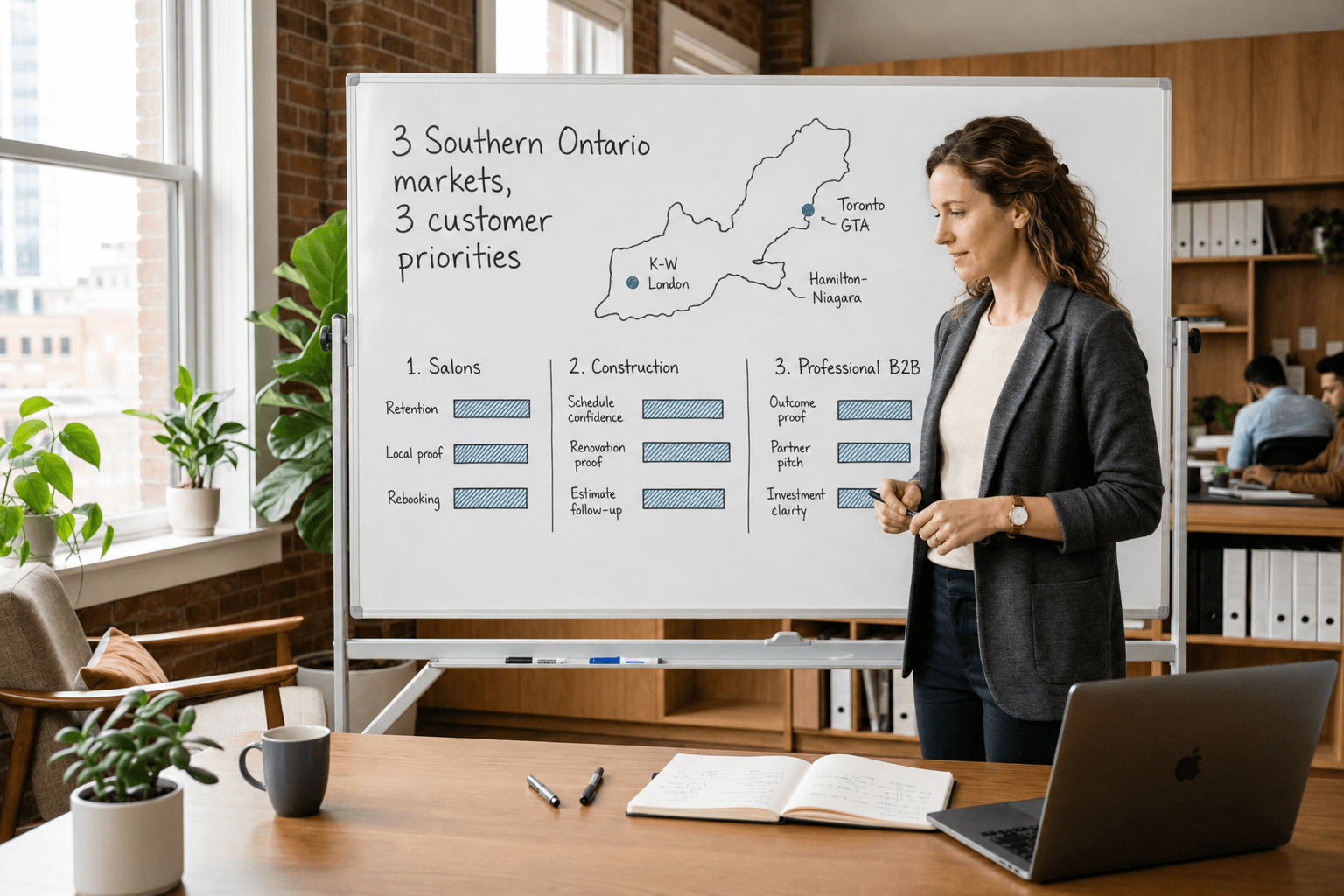
Salon and beauty operators across Toronto, Hamilton, Kitchener-Waterloo, London, and Niagara face rising labour costs, business churn where exits outpace entries, and cautious owner confidence. This brief ranks the regional signals that should shape retention, staffing, and local marketing decisions this quarter.
Regional pressure signals
Local businesses need sharper local intelligence when labour costs rise faster than pricing can absorb, and when more firms close than open in the same province.
Southern Ontario salon and beauty operators are not facing a single crisis. They are managing stacked pressures: wage inflation, a softer provincial labour market, tighter household budgets, higher expectations for local proof, and more competition for the same appointment slots across Toronto, Hamilton, Kitchener-Waterloo, London, and Niagara.
Three verified signals define the regional frame for this brief:
| Signal | Verified finding | Why it matters for salons |
|---|---|---|
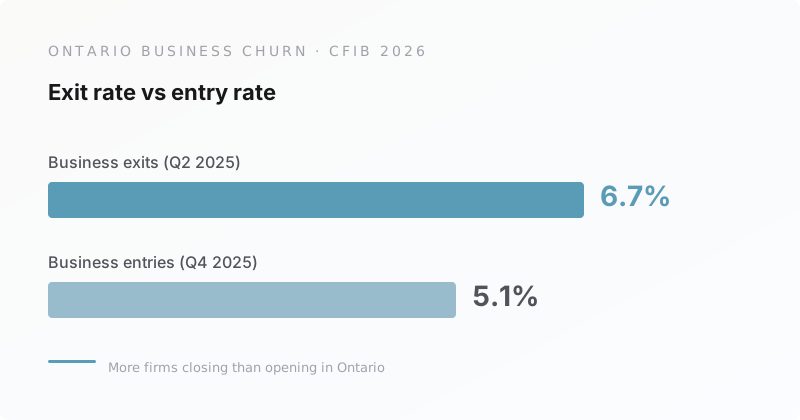
| Business churn | In Ontario, business exit rates reached 6.7% in Q2 2025 while entry rates fell to 5.1% by Q4 2025 (CFIB, 2026). | More operators are competing for a market where replacement capacity is shrinking. |
| Labour cost and slack | Ontario's average hourly wage rose to $37.72 in 2025, up 3.5% year over year, while the provincial unemployment rate rose to 7.7% (FAO Ontario, April 2026). | Chair revenue must cover labour before marketing spend, even as clients become more selective. |
| Owner outlook | Only 23% of Ontario businesses are confident in the provincial economy, while 52% are confident in their own prospects (OCC 2026 Ontario Economic Report). | Owners still push growth plans while treating the macro environment as fragile. |
Five-city snapshot
This brief uses a regional lens. City examples below illustrate where local intelligence changes decisions, not where every salon should copy the same tactic.
| City / region | Local angle for salons | Intelligence priority |
|---|---|---|
| Toronto | High density, high labour cost, strong demand for convenience and proof | Differentiate on retention and local reputation, not discount volume |
| Hamilton | Mixed income corridors, strong neighbourhood loyalty | Lead with neighbourhood-specific offers and visible client outcomes |
| Kitchener-Waterloo | Younger households, dual-income professionals | Package time-saving services and predictable rebooking |
| London | Stable local market, owner-operated competition | Win trust with consistent brand voice and staff-ready scripts |
| Niagara | Tourism plus local repeat clients | Seasonal campaigns need a year-round retention backbone |
What salon owners are actually deciding
Marketing directors, business owners, and franchise directors in beauty services are not asking for more content. They are trying to answer four practical questions:
- Which services still carry margin after wage and product cost increases?
- Which neighbourhoods respond to local proof versus generic trend posts?
- Which competitors win on convenience, price, or experience in each city corridor?
- Which messages staff can repeat without drifting off brand?
Generic AI prompts fail here because they flatten local context. A salon in Hamilton and a salon in Toronto may share a brand name and still need different local intelligence inputs.
Commercial signals worth tracking
The salons that win locally are not the loudest online. They are the most consistent where clients decide: search results, reviews, staff recommendations, and rebooking prompts.
Signal 1: Retention beats acquisition when churn pressure rises
When provincial business exits outpace entries, replacing lost clients costs more than keeping existing ones. Local intelligence should connect review themes, service mix, and rebooking rates before launching new campaigns.
Signal 2: Staff-ready messaging reduces brand drift
Salon teams lose margin when every stylist improvises retail and service language. Owners need local intelligence translated into short, repeatable scripts tied to verified offers and policies.
Signal 3: Local proof is a conversion asset, not a marketing extra
Clients comparing options in the same city respond to specific outcomes, named neighbourhoods, and visible consistency across Google, Instagram, and in-chair recommendations. Missing proof creates hesitation even when skill level is high.
Signal 4: Regional seasonality needs one source of truth
Niagara tourism peaks, university cycles in Waterloo, and Toronto commuter patterns all change demand timing. Campaigns fail when seasonal plans live in one person's notes instead of a shared local intelligence layer.
New customer acquisition for salons
Salon acquisition is won in the five inches between a Google result, a review, and a first booking, not in another generic beauty trend post.
In Southern Ontario beauty markets, new clients usually arrive through local search, Instagram discovery, referral language from existing clients, and walk-in or first-visit conversion in dense corridors. Discount-led acquisition burns margin when wages already sit at $37.72 average hourly and exits outpace entries province-wide. The salons that grow add clients by making neighbourhood proof, service packaging, and rebooking language consistent before they spend more on ads.
Acquisition that fits this industry looks like:
- Neighbourhood-specific offers that protect margin instead of racing to the lowest first-visit price
- Review and before/after proof that matches what clients search for in each city corridor
- Staff-ready booking and retail scripts so the first visit does not depend on one stylist's improvisation
- Seasonal capture plans for Niagara tourism, Waterloo student cycles, and Toronto convenience demand without abandoning year-round retention
How dnAI helps salon acquisition
dnAI turns your brand knowledge, services, policies, and local proof into acquisition assets your team can actually use:
- Local landing and social copy grounded in your real services, pricing rules, and neighbourhood positioning
- First-visit and rebooking scripts staff can repeat without drifting off brand
- Review-response and proof packages that convert searchers who are comparing two or three salons nearby
- Campaign calendars that sync acquisition pushes to local seasonality instead of generic beauty trends
- Competitor and message gap analysis so you know what to claim in Toronto, Hamilton, Kitchener-Waterloo, London, or Niagara
What a local intelligence briefing should produce
For salon operators in Southern Ontario, a useful briefing should leave the room with:
- A ranked list of local competitors and what they emphasize in each target city
- A margin-aware service and retail narrative staff can use this month
- A rebooking and proof plan tied to the neighbourhoods you actually serve
- A 90-day acquisition and message calendar grounded in local signals, not generic trend lists
We'd love to help you turn Southern Ontario market signals into a salon acquisition and retention plan your team can execute with confidence.
Methodology and sources
Scope: Public regional and industry signals for Southern Ontario salon and beauty operators. City examples include Toronto, Hamilton, Kitchener-Waterloo, London, and Niagara.
Interpretation: Findings marked as signals combine verified statistics with operational implications for owners and marketing leaders. They are not forecasts.
Primary sources (accessed July 19, 2026):
- Canadian Federation of Independent Business, entrepreneurial drought analysis and Ontario business entry/exit rates (2026 materials covering Q2 and Q4 2025 data)
- Financial Accountability Office of Ontario, Ontario's Labour Market in 2025 (released April 29, 2026)
- Ontario Chamber of Commerce, 2026 Ontario Economic Report (released February 19, 2026)
- Human dnAI client pattern library (salon retail and service messaging, anonymized)
Refresh cadence: Quarterly, or when provincial labour, business churn, or local competitor data shifts materially.
Local intelligence briefing
Turn regional signals into decisions for your business
This report summarizes verified Southern Ontario market signals. In a briefing, we map what they mean for your market, competitors, and next quarter priorities.
Book a local intelligence briefing