Southern Ontario local intelligence
Southern Ontario Professional B2B Local Intelligence Brief
Reports · Human BXG
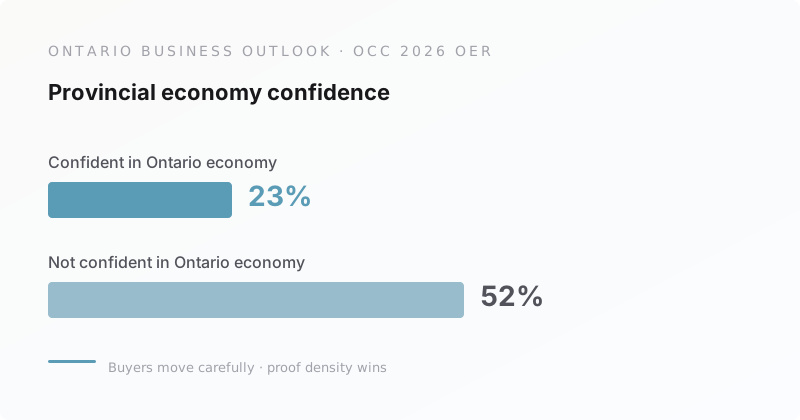
Agencies, consultancies, and professional services firms in Southern Ontario are selling into a market where only 23% of businesses trust the provincial outlook. This brief maps regional sentiment, investment caution, and city-level demand patterns for Toronto, Hamilton, Kitchener-Waterloo, London, and Niagara.
Regional pressure signals
Professional B2B firms lose margin when pipeline gets soft and every partner improvises the pitch. Local intelligence turns regional demand signals into one repeatable growth story.
Agencies, consultancies, IT and MSP providers, accounting firms, legal practices, and HR advisors across Southern Ontario are selling into a market that is resilient but not recovered. Owners still believe in their own firms, while buyer committees move carefully and demand clearer proof.
| Signal | Verified finding | Why it matters for professional B2B |
|---|---|---|
| Provincial confidence | Only 23% of Ontario businesses are confident in the provincial economy, down from 26% a year earlier; 52% are not confident in the outlook (OCC 2026 Ontario Economic Report). | Buyers delay decisions unless risk, cost, and outcomes are addressed directly. |
| Self-belief vs investment | 52% of businesses are confident in their own prospects, but only 26% plan to increase investment in 2026 (OCC, 2026). | Demand for advisory work exists, but capital and project budgets stay guarded. |
| Sales sentiment | Bank of Canada Q1 2026 Business Outlook Survey finds sentiment improving from 2025 lows, with future sales indicators back near historical average; recession-planning share fell to 9% from 22% (Bank of Canada, April 2026). | Conversations are opening again, but conversion still depends on proof density. |
| Macro baseline | Ontario Ministry of Finance projects real GDP growth of 1.0% in 2026 (2026 Ontario Budget). | Firms should plan for steady, selective demand, not an expansive spending cycle. |
Five-city snapshot
| City / region | Local angle for professional B2B | Intelligence priority |
|---|---|---|
| Toronto | Large buyer concentration, high competition, short attention spans | Lead with outcome specificity and executive-ready proof |
| Hamilton | Industrial and professional services mix, relationship-driven sales | Win with local references and sector fluency |
| Kitchener-Waterloo | Tech-forward buyers, scaling SMBs | Package implementation clarity and ROI language |
| London | Stable regional accounts, trust-heavy buying | Make credentials and process visible early |
| Niagara | Cross-border and tourism-linked business services | Align offers with seasonal cash-flow realities |
What professional services leaders are deciding
Marketing directors, business owners, and franchise directors in professional B2B services are trying to answer:
- Which local segments still have budget for advisory, implementation, or managed services?
- Which competitors own the proof narrative in each target city?
- Which offers should be productized versus kept bespoke?
- Which messages partners and sales teams can repeat without diluting the brand?
Commercial signals worth tracking
Signal 1: Outcome-led positioning beats capability lists
Buyers respond to quantified outcomes and role-specific risk reduction. Local intelligence should map which outcomes resonate in each city and sector cluster.
Signal 2: Proof density wins when confidence stays low
When only about one in four firms trusts the provincial outlook, visible case studies, references, and process transparency convert better than generic expertise claims.
Signal 3: Investment caution raises the bar for proposal clarity
With just 26% of firms planning higher investment in 2026, proposals need sharper scope, timing, and ROI language. Local intelligence should inform which offers can be productized now.
Signal 4: AI adoption raises the bar for credibility
52% of Ontario businesses report moderate or extensive use of emerging technologies, including AI (OCC, 2026). Professional firms must show governed expertise, not generic automation language.
New customer acquisition for professional B2B
B2B acquisition in Southern Ontario is proof density and partner-ready narrative, not more top-of-funnel volume for buyers who already distrust the outlook.
With only 23% of Ontario businesses confident in the provincial economy and just 26% planning higher investment in 2026, new client growth for agencies, consultancies, MSPs, accounting, legal, and HR firms depends on converting cautious committees. Referrals, LinkedIn, local networks, and RFP responses still matter, but they only convert when outcome language, references, and process clarity travel with every partner and salesperson.
Acquisition that fits this industry looks like:
- Outcome-led offers tied to specific city and sector clusters, not capability laundry lists
- Case studies and reference packs that reduce perceived risk for slow-moving buyer committees
- Partner and sales variants of the same pitch so franchise directors and principals do not invent conflicting stories
- Productized entry offers that fit guarded 2026 investment budgets while leaving room for deeper engagements
How dnAI helps professional B2B acquisition
dnAI turns your expertise, proof, and positioning into acquisition assets that stay consistent across the firm:
- Outcome-led website, LinkedIn, and proposal copy grounded in your real services and client results
- Case study and reference narratives buyers can evaluate quickly when confidence is low
- Partner-ready pitch variants for owners, marketing directors, and franchise directors without brand drift
- Productized offer language that matches cautious investment plans while protecting margin
- Pipeline content calendars tied to regional demand signals instead of generic thought-leadership volume
What a local intelligence briefing should produce
For professional B2B firms in Southern Ontario, a useful briefing should leave you with:
- A ranked view of local demand pockets by city and service line
- Competitor proof gaps you can claim in the next quarter
- A partner-ready pitch narrative with role-specific variants
- A 90-day acquisition and pipeline content plan tied to verified regional signals
We'd love to help you turn Southern Ontario B2B market signals into qualified briefings and sharper local positioning.
Methodology and sources
Scope: Public regional economic and buyer signals for professional B2B services in Southern Ontario. City examples include Toronto, Hamilton, Kitchener-Waterloo, London, and Niagara.
Interpretation: Signals combine verified statistics with go-to-market implications for owners and marketing leaders.
Primary sources (accessed July 19, 2026):
- Ontario Chamber of Commerce, 2026 Ontario Economic Report (released February 19, 2026; survey fielded October 16 to November 26, 2025)
- Bank of Canada, Business Outlook Survey, First Quarter of 2026 (released April 20, 2026)
- Ontario Ministry of Finance, 2026 Ontario Budget economic outlook (planning projections as of January 16, 2026)
- Human dnAI client pattern library (B2B positioning and content architecture insights, anonymized)
Refresh cadence: Quarterly after OCC, Bank of Canada, and provincial budget/update releases, or sooner when regional business sentiment shifts materially.
Local intelligence briefing
Turn regional signals into decisions for your business
This report summarizes verified Southern Ontario market signals. In a briefing, we map what they mean for your market, competitors, and next quarter priorities.
Book a local intelligence briefing