Southern Ontario local intelligence
Southern Ontario Construction Local Intelligence Brief
Reports · Human BXG

Construction and renovation firms across Southern Ontario are balancing June 2026 start softness with continued renovation demand and labour pressure. This brief connects verified housing, employment, and wage signals to local sales and proof priorities in five key markets.
Regional pressure signals
Construction firms win locally when they can explain schedule confidence, labour availability, and renovation ROI in the same language their buyers use in each city.
Southern Ontario builders, renovators, and trade-adjacent firms are mid-2026 with mixed signals. New-start volume remains soft, renovation demand stays strategically important, and labour costs still shape bid confidence across Toronto, Hamilton, Kitchener-Waterloo, London, and Niagara.
| Signal | Verified finding | Why it matters for construction |
|---|---|---|
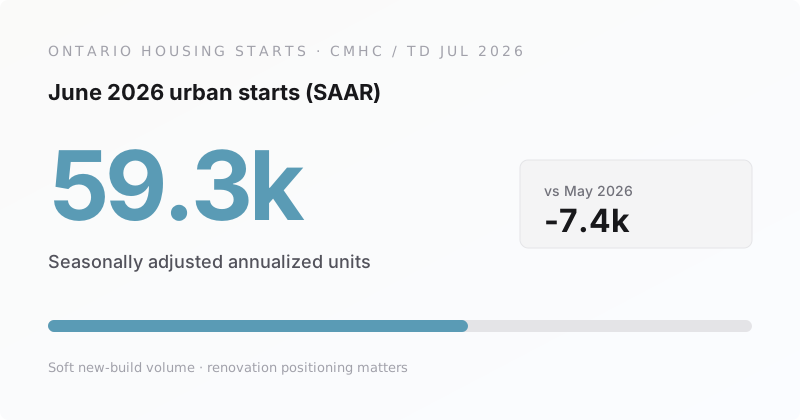
| Current starts | Ontario urban housing starts fell to 59,300 seasonally adjusted annualized units in June 2026, down 7,400 from May (TD Economics analysis of CMHC data, July 16, 2026). | Near-term pipeline messaging must assume soft new-build volume, not a rebound already in hand. |
| National trend | Canada's six-month housing starts trend fell 2.8% in June 2026 to 248,123 units, the lowest level in a year (CMHC, July 2026). | National softness confirms the pressure Southern Ontario firms are already feeling in sales cycles. |
| Outlook | CMHC projects Ontario overall housing starts could fall to near two-decade lows in 2026, with a modest rebound afterward (CMHC Housing Market Outlook 2026). | Firms overly dependent on new-build volume need clearer renovation and commercial positioning. |
| Labour cost | Ontario's average hourly wage reached $37.72 in 2025, up 3.5% (FAO Ontario, April 2026). | Estimate accuracy and margin protection depend on current labour assumptions. |
Five-city snapshot
| City / region | Local angle for construction | Intelligence priority |
|---|---|---|
| Toronto | High-value renovations, strict timelines, proof-heavy buyers | Show process control and minimal-disruption delivery |
| Hamilton | Mixed housing stock, strong infill and retrofit opportunity | Lead with durability and neighbourhood-specific outcomes |
| Kitchener-Waterloo | Growth corridors plus established suburbs | Align messaging with dual-income household priorities |
| London | Owner-led firms competing on trust | Make credentials, process, and communication visible early |
| Niagara | Seasonal demand swings, tourism-adjacent commercial work | Balance peak-season campaigns with year-round pipeline proof |
What construction leaders are deciding
Owners and marketing directors in construction and renovation are trying to resolve four decisions at once:
- Which project types still support margin when labour and material inputs stay elevated?
- Which buyers prioritize speed, quality, or minimal disruption in each local market?
- Which competitors win on proof versus price in the same service category?
- Which sales and estimating messages stay consistent across estimators, PMs, and client-facing staff?
Commercial signals worth tracking
Signal 1: Renovation proof outranks generic craftsmanship language
High-end and mid-market homeowners respond when firms show how complexity is handled for them, not when firms publish another generic "quality matters" post. Local intelligence should translate project patterns into buyer-specific reassurance.
Signal 2: Schedule confidence is a sales asset
Buyers comparing firms in the same city often choose the team that makes timeline risk legible. That requires local intelligence on labour constraints, permit patterns, and recent comparable projects.
Signal 3: Segment-specific messaging beats one website for every buyer
Residential luxury, professional households, and commercial tenants evaluate different risks. A single undifferentiated message underperforms in every segment.
Signal 4: Soft starts data should change offer design, not just ad spend
When June starts pull back and the annual outlook stays weak, firms that reposition toward renovations, retrofits, and maintenance contracts early retain pipeline stability.
New customer acquisition for construction
In a soft starts market, construction acquisition is estimate conversion and renovation proof, not louder brand advertising.
With Ontario urban starts at 59,300 SAAR units in June 2026, new customer growth for builders and renovators depends on winning buyers who are comparing timeline risk, disruption, and renovation ROI. Generic craftsmanship claims do not move homeowners or commercial tenants. Acquisition happens in search, referral handoffs, estimate follow-ups, and segment-specific proof that makes schedule confidence legible before the bid is awarded.
Acquisition that fits this industry looks like:
- Renovation and retrofit offers positioned for buyers pausing new-build decisions
- Case studies and process proof that answer "will this finish on time and with minimal disruption?"
- Segment-specific pages and follow-ups for residential luxury, professional households, and commercial tenants
- Consistent estimating and PM language so the first conversation matches the proposal and the jobsite update
How dnAI helps construction acquisition
dnAI turns your project history, service mix, and brand rules into acquisition tools for sales and marketing:
- Estimate follow-up sequences and proposal language grounded in your real process, warranties, and timelines
- Case study and proof drafts that show how you handle complexity in specific Southern Ontario markets
- Segment messaging for residential versus commercial buyers without maintaining three disconnected websites
- Local content that supports renovation, retrofit, and maintenance demand while new starts stay soft
- Sales-enablement scripts estimators and PMs can share so every new lead hears the same credible story
What a local intelligence briefing should produce
For construction and renovation firms in Southern Ontario, a useful briefing should deliver:
- Segment-specific message priorities for residential and commercial buyers in your target cities
- Competitor positioning gaps you can claim with proof
- A proof plan for case studies, timelines, and estimate follow-ups
- A 90-day acquisition and sales-enablement map tied to verified regional signals
We'd love to help you convert Southern Ontario construction market signals into qualified conversations and clearer bids.
Methodology and sources
Scope: Public regional construction signals for Southern Ontario. Examples reference Toronto, Hamilton, Kitchener-Waterloo, London, and Niagara.
Interpretation: Signals combine verified statistics with buyer-behavior implications for owners and marketing leaders.
Primary sources (accessed July 19, 2026):
- Canada Mortgage and Housing Corporation, housing starts and construction data for June 2026 (released July 16, 2026)
- TD Economics, Canadian Housing Starts (June 2026) (published July 16, 2026)
- Canada Mortgage and Housing Corporation, Housing Market Outlook 2026
- Financial Accountability Office of Ontario, Ontario's Labour Market in 2025 (released April 29, 2026)
- BuildForce Canada, Ontario construction and maintenance outlook materials (residential recovery and renovation demand framing)
- Human dnAI client pattern library (renovation and lead-gen messaging, anonymized)
Refresh cadence: Monthly for starts data; quarterly for outlook and labour assumptions, or sooner when municipal permit trends shift materially.
Local intelligence briefing
Turn regional signals into decisions for your business
This report summarizes verified Southern Ontario market signals. In a briefing, we map what they mean for your market, competitors, and next quarter priorities.
Book a local intelligence briefing