How to Prepare a High‑Confidence Post Using Deep Research (Without Guessing or Second‑Guessing)
How-To · Human dnAI Team
How to Prepare a High‑Confidence Post Using Deep Research (Without Guessing or Second‑Guessing)
Who This Is For
- Marketing directors who want every post to stand up to scrutiny
- Solo or small marketing teams who cannot afford rewrites
- dnAI users who want research to actually guide content decisions
The Problem (Why This Matters)
Most posts fail quietly.
They are published, they look fine, but something feels off. The message is vague, the angle is soft, and confidence is missing. That usually happens because the post was built on assumptions instead of evidence.
Deep Research exists to fix that. It gives you a clear view of the market before you write, then locks that clarity into your Knowledge Base so you are not reinventing the wheel every time.
What You’ll Achieve by the End
- Prepare a post grounded in real market insight
- Eliminate guesswork from positioning and messaging
- Save research so future content stays aligned
- Write faster, with more confidence and fewer revisions
Step‑by‑Step Instructions
Step 1: Decide the Purpose of Your Post
Before opening dnAI, answer one question in plain language:
What decision should this post help the reader make?
Examples:
- Trust our expertise
- Reconsider how they approach research
- See a new way of working with AI
Why this matters: Deep Research is strongest when it supports a clear outcome, not a vague idea.
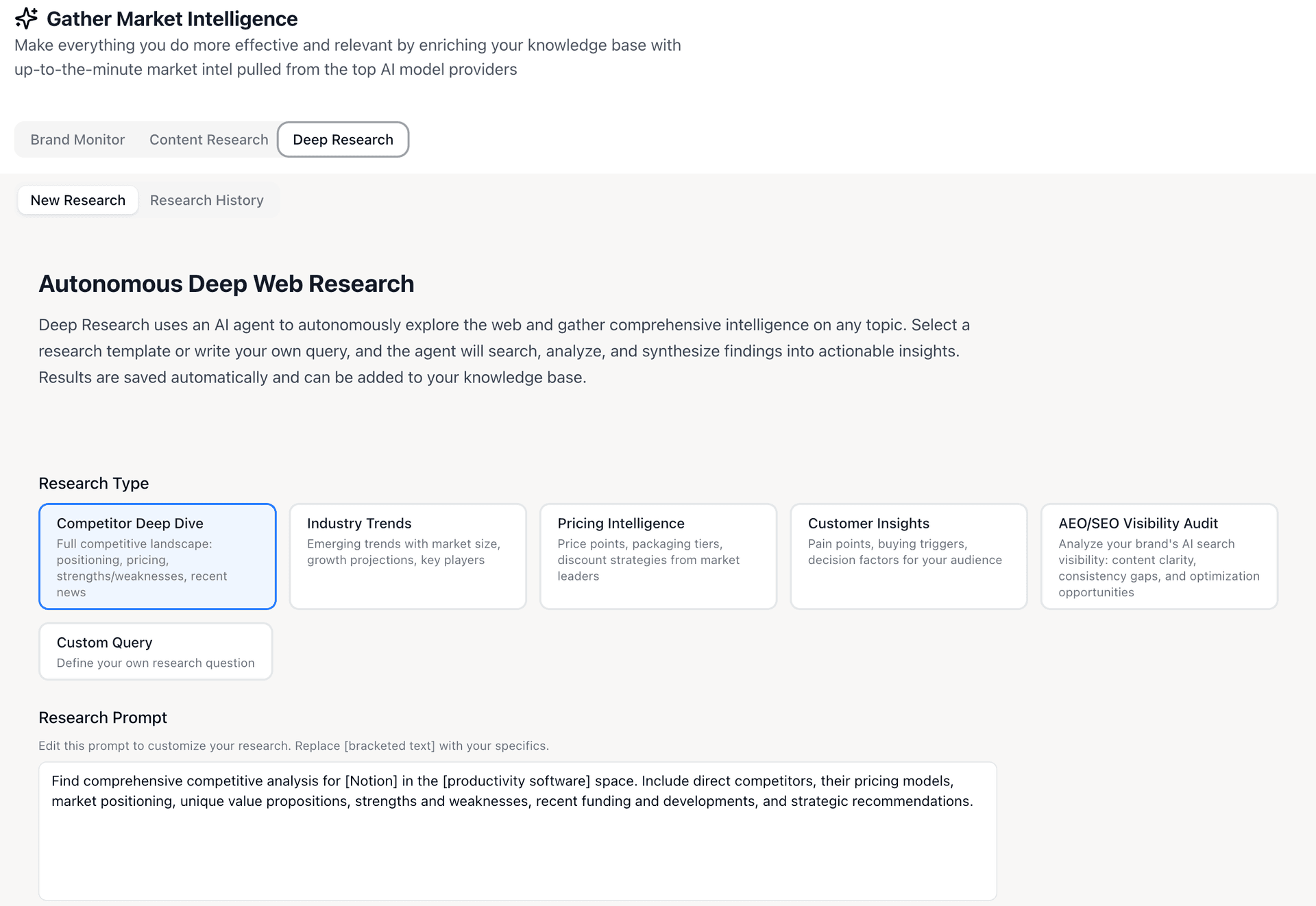
Step 2: Open Deep Research
- Go to Market Intelligence
- Select Deep Research
- Choose New Research unless you already have relevant saved research
This is where outside signal becomes internal truth.
Step 3: Choose the Right Research Type
Pick the research type that matches your post goal:
- Industry Trends for thought leadership posts
- Customer Insights for audience‑led messaging
- Competitor Deep Dive for positioning or comparison posts
- AEO / SEO Visibility Audit for posts about AI discovery and search
- Custom Query if your angle is specific
Tip: If your post is about clarity, confidence, or direction, Industry Trends or Customer Insights usually perform best.
Step 4: Customize the Prompt for Writing
Edit the example prompt so it clearly supports your post.
Include:
- The audience you are writing for
- The topic your post will address
- The question your post should answer
Simple test: If someone else read this prompt, would they know exactly what the post will be about?
If not, refine it.
Step 5: Run Deep Research
- Confirm you have 10 credits available
- Click Start Deep Research
- Wait 5–10 minutes without refreshing
The agent is gathering sources, validating patterns, and synthesizing insight so you do not have to.
Step 6: Review With a Writer’s Eye
When the results are ready, focus on three things:
- Executive summary for the core narrative
- Key findings for proof points and language
- Three prioritized action items, these often become post angles or closing insights
Do not copy everything. You are looking for clarity, not volume.
Step 7: Save to the Knowledge Base
This step is essential.
- Click Save to KB
- Confirm it is saved
Why this matters: Saved research becomes part of your brand’s shared truth. Future posts, pages, and workflows will pull from it automatically.
Step 8: Draft the Post Using the Research
Now write the post using this simple structure:
- Open with the tension or problem the research revealed
- Share one or two clear insights, not a data dump
- Explain what changes when you act on that insight
- Close with confidence, not a hard sell
You are not quoting research, you are standing on it.
Common Mistakes to Avoid
- Writing before running research
- Using vague prompts like “AI trends”
- Ignoring the action items
- Forgetting to save research to the Knowledge Base
- Treating research as decoration instead of direction
Optional Pro Tips
- Reuse saved research for multiple posts
- Pair one research report with a short post series
- Let research guide tone as much as content
Simple Checklist
- Define the post’s purpose
- Open Market Intelligence → Deep Research
- Select the right research type
- Customize the prompt clearly
- Run Deep Research
- Review summary and action items
- Save to Knowledge Base
- Write the post from insight, not instinct
Final Thought
Confidence does not come from sounding smart.
It comes from knowing you are right.
When research leads and writing follows, your posts stop feeling like opinions and start feeling like signals. That is the difference readers notice, even if they cannot explain it.
This is what happens when AI is built around you, not everyone else.
Build from your Brand DNA